The three levers you actually control
The Canadian Conservation Institute's preventive framework for ceramics and glass comes down to environment, handling, and organization: clean, environmentally controlled conditions, and storage and display arranged so objects are handled as rarely as possible.[1]
Environment: a stable, climate-controlled interior room. Not the attic, not the garage, not anywhere the seasons reach.[1]
Handling: every touch is risk; glass and ceramics break more easily than nearly anything else in a home.[1] Museum handling rules (underneath, one at a time, padded surface) are in our cleaning guide.[2]
Materials: only inert, archival materials touch the piece: unbuffered acid-free tissue, polyethylene foam, archival board (see storage).[3]
Know the warning sign: weeping glass
Old glass has a specific failure mode conservators call weeping: liquid droplets form on the surface as atmospheric moisture leaches components out of the glass itself, leaving a cloudy, disintegrating surface layer.[4] It looks like the ornament is sweating.
An heirloom needs a paper trail
Preservation isn't only physical. A piece's story (who bought it, where, which tree it hung on) is the part no conservator can restore once it's lost. Photograph each significant ornament, write down what you know, and keep the notes with the collection. Your grandchildren will know which box mattered.
The annual minute
Once a year, at unpacking or repacking, give each significant piece sixty seconds: look for new chips, lifting or flaking decoration, moisture, corrosion at the cap. Condition problems caught at "small" stay small; every category on that list is one the Park Service routes to a conservator once it's visible.[2]
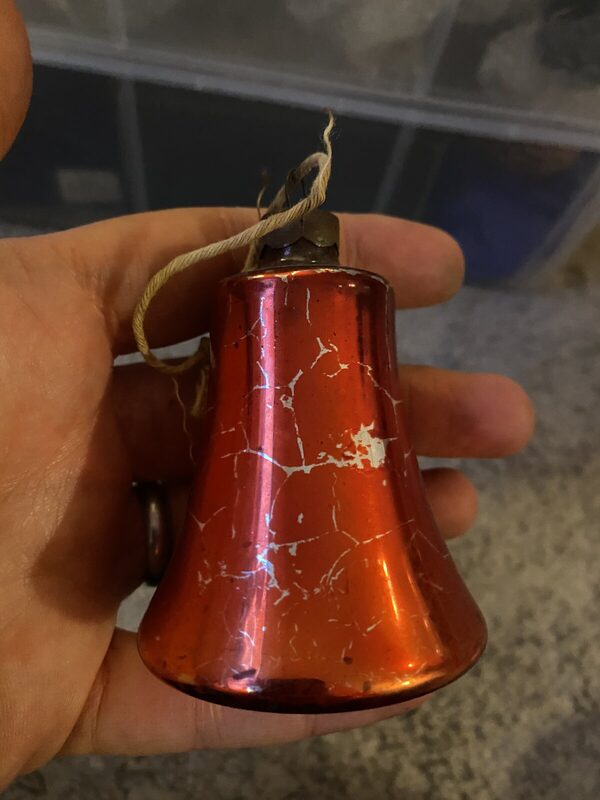
A red bell wearing its history
From our own shelves: a glass bell with paint worn honestly through to the silvering. Pieces like this are why the annual one-minute inspection exists.
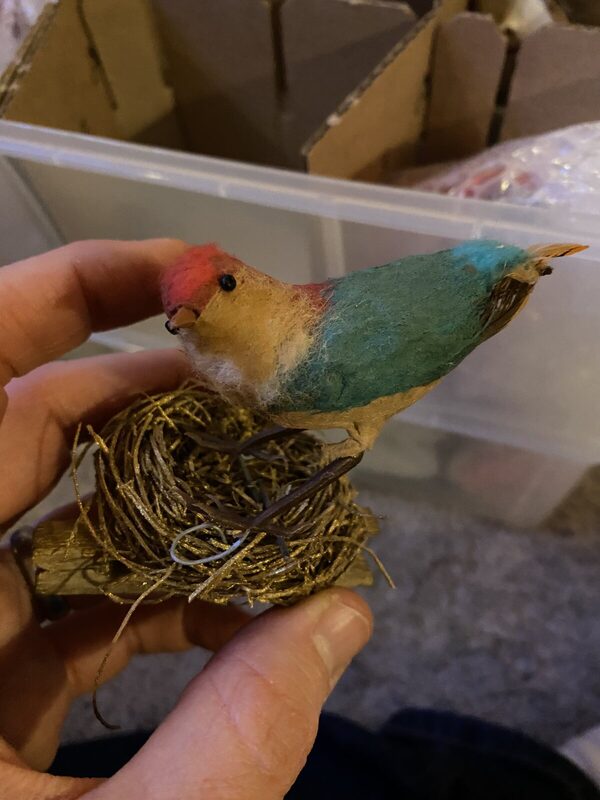
A cotton bird on its nest
A soft-bodied bird with a natural nest, the class of mixed-material piece where unbuffered tissue and minimal handling earn their keep.
Sources
- Canadian Conservation Institute, "Caring for ceramic and glass objects: preventive conservation guidelines".
- National Park Service, Conserve O Gram 8/1: "Removing Dust from Ceramic and Glass Objects".
- National Park Service, Conserve O Gram 4/9: "Buffered and Unbuffered Storage Materials".
- Canadian Conservation Institute, CCI Notes 5/1: "Care of Ceramics and Glass" (weeping glass).
- American Institute for Conservation, "Find a Conservator" directory.